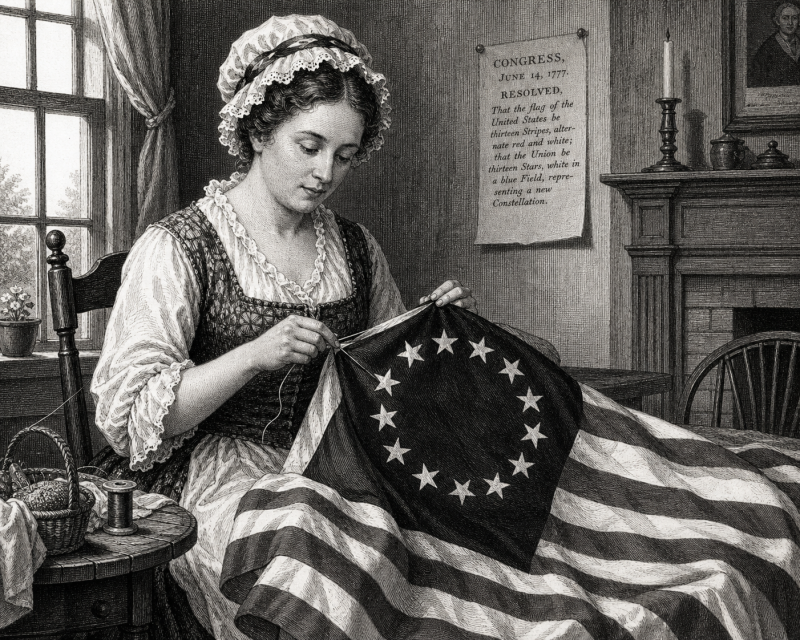
Part 1: The Real Elizabeth Griscom — Beyond the Stars and Stripes
When we hear the name Betsy Ross, our minds immediately go to a quiet room, a sewing basket, and a circle of thirteen stars. But before she was an American icon, Betsy Ross was Elizabeth Griscom, a fierce and talented upholsterer navigating the chaotic streets of revolutionary Philadelphia [1].
A Master of Her Craft
Born into a Quaker family in 1752, Betsy was the eighth of seventeen children. She didn't just "sew" as a hobby; she was a highly trained professional. She apprenticed with William Webster, a prominent Philadelphia upholsterer, where she learned the complex trade of making curtains, bedcovers, and—crucially—flags [2].
Defying Tradition: Three Marriages and a Revolution
Betsy’s personal life was as tumultuous as the era she lived in. Her resilience is best seen through her three marriages, two of which left her a young widow during the height of the conflict.
- John Ross (1773): Betsy risked everything for her first love. She was "read out" (expelled) from the Quaker community for marrying John, an Anglican. Together, they started an upholstery business. However, John died in January 1776 while serving in the local militia [3].
- Joseph Ashburn (1777): Betsy married Joseph, a mariner, a year after the signing of the Declaration of Independence. Joseph was eventually captured by the British and died in the notorious Old Mill Prison in England in 1782 [4].
- John Claypoole (1783): John was an old friend and fellow prisoner of Joseph Ashburn. He returned to Philadelphia to bring Betsy the news of her second husband's death. They married in 1783 and had five daughters together [1].
A Legacy Continued: The Daughters of Betsy Ross
Through John Claypoole, Betsy became the matriarch of a large family. She had five daughters who lived to adulthood: Clarissa, Elizabeth, Susannah, Rachel, and Jane. As Betsy’s eyesight began to fail in her later years, her daughters (particularly Clarissa) took over much of the upholstery and flag-making work, sustaining the business into the 19th century [2].
The "Fighting Quaker"
Even after her expulsion, Betsy and John Claypoole became active members of the Free Quakers, a group that supported the American war effort, unlike the pacifist mainstream Quakers [3].
Part 2: The Legend of the Flag — Fact vs. Folklore
In 1870, nearly a century after the Revolution, Betsy Ross’s grandson, William Canby, stood before the Historical Society of Pennsylvania. He told a story that would change American history books: that in June 1776, George Washington, Robert Morris, and George Ross visited Betsy’s shop to ask her to create the first national flag [5].
The Famous Meeting
According to the legend, Washington presented a rough sketch of a flag with thirteen stripes and thirteen six-pointed stars. Betsy supposedly suggested a five-pointed star instead because it was easier to cut with a single snip of the scissors [6].
What Does the Evidence Say?
As historians, we must look at the "paper trail":
- The Pro: There are records of Betsy Ross being paid by the Pennsylvania State Navy Board for making flags [4].
- The Con: There is no written record from 1776—no diary entries from Washington or receipts from the Continental Congress—confirming this specific meeting [5].
Why the Story Emerged
The story gained massive popularity during the 1876 Centennial. America was looking for heroes, and the image of a "Founding Mother" resonated deeply. Whether the meeting happened exactly as described or not, Betsy Ross became the face of female contribution to the nation [6].
Part 3: The Legacy of a "Founding Mother" in the Classroom
As educators, how do we handle the "Betsy Ross problem"? The answer lies in teaching both the facts and the folklore.
The Value of Historical Myth
Legends like Betsy Ross’s tell us what a culture values. Her story honors the "domestic sphere"—the idea that the Revolution was fought in homes and shops as much as on battlefields [7].
Critical Thinking Opportunities
The Betsy Ross story is a perfect case study for students:
- Primary vs. Secondary Sources: Compare Canby’s 1870 account with actual 1776 records [5].
- The Role of Women: Use Betsy to discuss working-class women during the war [7].
- The Evolution of Symbols: How did we choose the flag as our primary national symbol?
Beyond the Needle
Ultimately, Betsy Ross represents the thousands of unnamed women who ran businesses, managed farms, and supported liberty while the "Founding Fathers" debated in the State House [1].
Citations
- Miller, M. H. (2010). Betsy Ross and the Making of America. St. Martin's Press.
- Ulrich, L. T. (2007). The Age of Homespun: Objects and Stories in the Creation of an American Myth. Knopf.
- Leepson, M. (2005). Flag: An American Biography. St. Martin's Griffin.
- Pennsylvania Navy Board Records (1777). Payment Receipts for Flag Making: Elizabeth Ross. Pennsylvania State Archives.
- Canby, W. J. (1870). The History of the Flag of the United States. Address to the Historical Society of Pennsylvania.
- Hartvigsen, R. (2010). The Betsy Ross Story: My Life as a Flag Maker. Journal of the American Revolution.
- Berkin, C. (2005). Revolutionary Mothers: Women in the Struggle for America's Independence. Vintage.