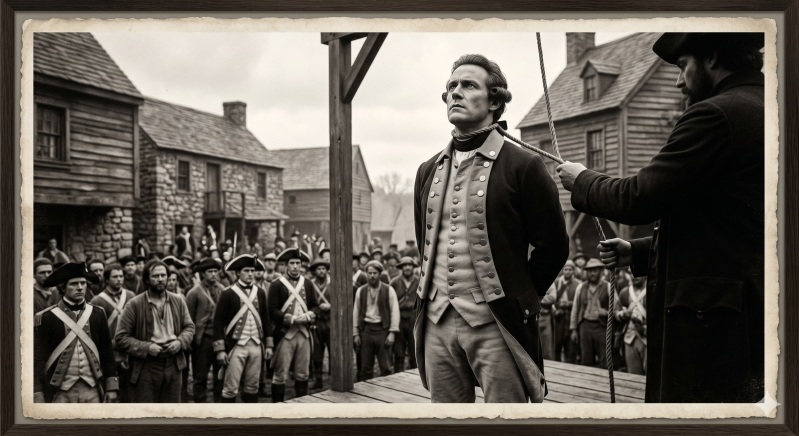
Part I: The Making of a Patriot — Nathan Hale Before the Revolution
Before he became a martyr of the American cause, Nathan Hale was a product of colonial New England—a world defined by rigid piety, classical education, and a growing unease with British authority.
Born in 1755 in Coventry, Connecticut, Hale was raised in a devout Puritan household. His upbringing emphasized discipline, moral duty, and intellectual rigor—qualities that would later define his brief but remarkable life. From an early age, Hale displayed academic promise, eventually enrolling at Yale College at just sixteen.
At Yale, Hale was immersed in Enlightenment thought and classical ideals. He studied literature, philosophy, and rhetoric, developing a deep admiration for civic virtue and sacrifice—concepts rooted in ancient Roman history. Like many of his peers, he was influenced by the growing ideological divide between the colonies and Great Britain.
After graduating in 1773, Hale became a schoolteacher, first in East Haddam and later in New London. His students reportedly admired his enthusiasm and fairness, and his letters reveal a young man deeply committed to personal improvement and public duty.
Yet, the calm of academic life would soon be overtaken by the storm of revolution. The events of 1775—particularly the Battles of Lexington and Concord—ignited a transformation in Hale. What had been philosophical conviction turned into action.
Inspired by both ideology and duty, Hale joined the Continental Army, accepting a commission as a lieutenant under George Washington. His transition from educator to soldier reflected a broader colonial shift—men of intellect and principle stepping into the uncertain arena of war.
Still, nothing in his early life suggested the role he would soon take on—a role far more dangerous than the battlefield.
Part II: Into the Shadows — Hale’s Espionage Mission
By 1776, the war for independence had intensified, and George Washington faced a critical problem: intelligence.
The Continental Army was outmatched by British forces in both numbers and resources. To survive, Washington needed information—troop movements, strategies, and vulnerabilities. This necessity gave rise to one of the earliest American intelligence efforts.
It was in this context that Nathan Hale volunteered for a mission that others refused.
Disguised as a Dutch schoolmaster, Hale crossed into British-occupied New York City in September 1776. The city had recently fallen after the Continental Army’s defeat at the Battle of Long Island, making it a dangerous stronghold of British power.
Espionage in the 18th century was a perilous undertaking. Unlike soldiers, spies were denied the protections of war. If captured, they faced immediate execution. Hale had no formal training, no established network, and no reliable extraction plan—only determination and a sense of duty.
For several days, he gathered intelligence, observing British troop positions and fortifications. However, his cover was thin, and the environment hostile. Accounts vary, but it is widely believed he was betrayed—possibly by a Loyalist or even someone he trusted.
Captured by British forces under General William Howe, Hale’s fate was sealed almost immediately. He was found carrying incriminating documents, leaving little doubt about his mission.
In an era when espionage was considered dishonorable, Hale’s actions stood in stark contrast to contemporary norms. He was not driven by personal gain or coercion, but by a conviction that the American cause justified even the most dangerous forms of service.
Part III: “I Only Regret…” — Death and Legacy
On September 22, 1776, Nathan Hale was executed by hanging in New York City. He was just 21 years old.
There was no trial. No formal proceedings. In the eyes of the British, Hale was a spy—nothing more.
Yet, it was in these final moments that Hale’s legacy was forged.
According to later accounts, Hale delivered a statement that would echo through American history:
“I only regret that I have but one life to lose for my country.”
While historians debate the exact wording—no verbatim transcript exists—the sentiment reflects the ideals Hale embodied: sacrifice, patriotism, and unwavering commitment.
Hale’s death did not immediately alter the course of the war. In fact, his mission had failed, yielding little actionable intelligence. But his execution had a profound symbolic impact.
For the Continental Army and the broader Patriot cause, Hale became a martyr—a figure whose sacrifice illustrated the moral stakes of the revolution. His story circulated widely, inspiring soldiers and civilians alike.
Over time, Hale’s legacy grew. During the 19th century, as the United States sought to define its national identity, figures like Hale were elevated as embodiments of American virtue. His image appeared in statues, literature, and educational curricula.
Today, he is remembered not for military victories, but for something rarer: a willingness to face death for an idea.
In the evolution of American intelligence, Hale is often seen as a precursor to more sophisticated efforts, such as the Culper Spy Ring. Though inexperienced, his mission marked an early recognition of intelligence as a critical component of warfare.
Closing Reflection
The story of Nathan Hale is one of paradox. He was an untrained spy whose mission failed, yet his legacy succeeded beyond measure.
For historians, Hale offers a lens into the values of the Revolutionary generation—where Enlightenment ideals met the brutal realities of war. His life raises enduring questions:
What defines heroism—success or sacrifice?
How do nations construct memory from failure?
And how does a single moment shape centuries of identity?
Add comment
Comments