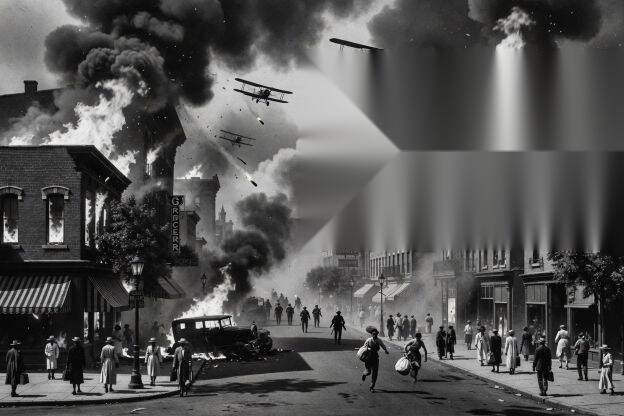
The story of the Tulsa Race Massacre isn’t just a "dark chapter" in American history; it is a profound testament to both the heights of Black excellence and the devastating depths of racial animosity. For your blog, capturing the dual nature of Greenwood—the prosperity before and the ash after—is key to helping your readers understand the gravity of what was lost.
The Beacon: "Black Wall Street"
Long before the smoke cleared in 1921, the Greenwood District of Tulsa was a miracle of the Jim Crow era. Prevented from shopping in white businesses, the Black community built their own empire. It was a self-contained economy of doctors, lawyers, luxury hotels, and indoor plumbing—features many white neighborhoods in Tulsa didn’t even have yet.
The Scale: Over 35 city blocks of bustling commerce.
The Spirit: It was known as the "Negro Wall Street" (a term popularized by Booker T. Washington), symbolizing Black self-sufficiency and economic power.
The Spark and the Powder Keg
History often focuses on a single moment as the "cause," but in reality, 1921 Tulsa was a powder keg of post-WWI tension and KKK influence. The match was struck in an elevator.
On May 30, 1921, a young Black shoeshiner named Dick Rowland entered an elevator operated by a white woman, Sarah Page. While what actually happened remains a mystery, a scream was heard, and Rowland was accused of assault. By the next morning, the Tulsa Tribune had published a sensationalized headline, and an angry white mob gathered at the courthouse.
When a group of armed Black WWI veterans arrived to protect Rowland from a potential lynching, a shot was fired. In that moment, the standoff turned into a full-scale invasion.
24 Hours of Devastation
Between May 31 and June 1, the Greenwood District was systematically dismantled. This wasn't just a "riot"—a term long used to shift blame—it was a coordinated assault.
The Aerial Attack
One of the most chilling aspects for your readers will be the use of private aircraft. Witnesses reported planes dropping kerosene bombs and firing rifles from the air, making it one of the first domestic aerial bombings on U.S. soil.
The Human and Material Cost
Casualties: While the official death toll at the time was 36, modern historians estimate the number is closer to 300.
Property: Over 1,200 homes were burned to the ground.
Displacement: Nearly 10,000 people were left homeless, many forced into internment camps run by the National Guard.
The Great Silence
Perhaps the most haunting part of the Tulsa story is the collective amnesia that followed. For decades, the massacre was omitted from history books, local newspapers, and even family conversations. The survivors were often too traumatized to speak, and the city of Tulsa literally paved over the trauma.
It wasn't until the 1990s and the early 2000s—thanks to the work of the Oklahoma Commission to Study the Tulsa Race Riot of 1921—that the truth began to resurface in the national consciousness.
The Sunset Standoff (May 31, 7:30 PM – 10:00 PM)
The tension began at the Tulsa County Courthouse. As a white mob grew to over 2,000, rumors of a lynching spread to Greenwood. In response, a group of about 75 Black men—many still in their World War I uniforms—marrived to offer the Sheriff their assistance in protecting Dick Rowland.
The Catalyst: A white man attempted to disarm a Black veteran. A struggle ensued, a shot rang out, and the "riot" officially began.
The Retreat: Outnumbered, the Black defenders retreated toward Greenwood, fighting a rearguard action as the mob followed them, looting hardware stores for more ammunition along the way.
The Midnight Siege (June 1, 12:00 AM – 5:00 AM)
As Tuesday turned to Wednesday, the violence turned into a tactical invasion. The Frisco railroad tracks, which separated the white and Black sections of town, became a literal frontline.
The "Special Deputies": In a move that would define the illegality of the night, the Tulsa Police Department "deputized" hundreds of white rioters. These men were given badges and instructions to "get a gun and get a n****r."
The Machine Gun: Witnesses reported a machine gun being mounted on a grain elevator or a truck, raining indiscriminate fire down on the residential streets of Greenwood to keep defenders pinned down.
The "Daybreak" Signal (June 1, 5:00 AM – 9:00 AM)
At dawn, a whistle blew—some say from the local brickyard—and the full-scale invasion commenced. This was the most lethal period of the massacre.
The Aerial Assault
This is the moment the massacre moved from the ground to the sky. At least a dozen private planes took off from nearby Curtiss-Southwest Field.
Eyewitness Account: Survivors like Buck Colbert Franklin described seeing "turpentine balls" and burning rags dropped onto the roofs of homes.
Tactical Purpose: The planes served two roles: reconnaissance to spot fleeing residents and active arson to ensure the fires spread faster than they could be fought.
The Scorched Earth
Rioters moved house-to-house. The pattern was chillingly consistent:
Looting: Families were forced out at gunpoint while the mob stripped the homes of jewelry, furs, and heirlooms.
Arson: Once cleared, the houses were set ablaze.
The Church: The Mount Zion Baptist Church, a brand-new $92,000 brick structure that represented the community's pride, was specifically targeted and burned to a shell.
The Aftermath and Internment (June 1, 9:00 AM – Noon)
By the time the National Guard arrived in full force and declared Martial Law at 11:29 AM, Greenwood was already gone.
Mass Arrests: Ironically, the National Guard did not arrest the white rioters. Instead, they rounded up nearly 6,000 Black residents and marched them at gunpoint to internment camps at the Convention Hall and the McNulty Baseball Park.
The Green Cards: For days, Black citizens could only be released if a white employer "vouched" for them and they agreed to wear a green tag identifying them as "compliant."
Direct Sources for My Article
If you want to give your readers the "raw" data of these 24 hours, I recommend referencing these specific documents:
The Red Cross Report (1921): This provides the most accurate immediate count of the homeless and the medical treatment provided in the days after the smoke cleared.
The 1921 Graves Investigation: Modern updates on the search for mass graves, proving that the scale of death was far higher than the 1921 "official" count.
History isn't just about what happened; it’s about how we choose to remember it. By writing this, you're helping to ensure that the "Greenwood spirit" isn't defined only by its destruction, but by the resilience of the people who built it.
End Of Pt, 1