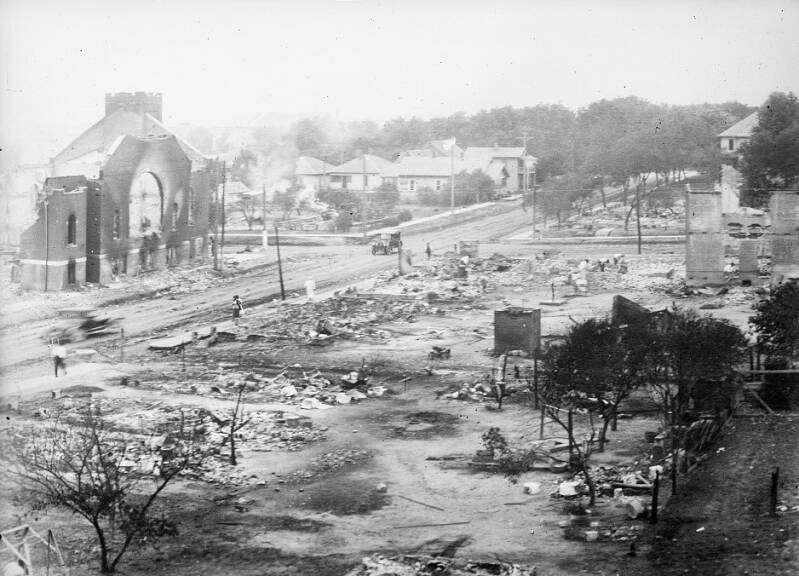
The Narrative Gap: 1921 vs. Today
Feature
The 1921 "Official Story"
The Historical Reality (Post-2001)
The Label:
A "Race Riot" caused by Black lawlessness.
A Massacre and state-sanctioned invasion.
Casualties
36 deaths (mostly Black "rioters").
An estimated 100 to 300+ deaths; many in mass graves.
Property Loss
Minimal; blamed on "unfortunate fires."
1,256 homes destroyed; 35 blocks leveled.
Police Role
Attempting to restore order.
Deputized the mob; provided weapons and immunity.
Air Support
Non-existent or "patrol only."
Confirmed aerial firebombing and sniping from planes.
The "Cause"
An attempted assault in an elevator.
Pre-planned white supremacy & economic resentment.
Insurance
Claims denied due to "riot" clauses.
A systemic wealth theft totaling millions (in 1921 dollars).
Export to Sheets
The Blueprint of Resilience
The story of the 1921 Tulsa Race Massacre is often told as a story of what was taken away. But for the historian, the more profound story is what was held onto. Despite the aerial firebombing, the mass internment, and the legal maneuvers designed to steal their land, the survivors of Greenwood did not simply disappear.
They stayed. They sued. They rebuilt.
By the mid-1920s, the "Negro Wall Street" had risen again, proving that the community’s wealth wasn't just in its bank accounts, but in its collective brilliance and refusal to be erased. The Strategy of
Rebuilding: "The Greenwood Blueprint"
When the city of Tulsa attempted to permanently seize the land through Ordinance 2156—which required new buildings to be made of fireproof brick, knowing most Black families had lost everything and couldn't afford the materials—the community launched a counter-offensive.
Legal Guerilla Warfare: Attorneys like Buck Colbert Franklin realized that the city’s intent was to force Black residents into homelessness so they would leave Tulsa permanently. Franklin organized the community to challenge the ordinance in court. He successfully argued that it was an unconstitutional taking of private property, effectively keeping the title of the land in the hands of the original Black owners.
Communal Capital: With banks refusing to lend to Black residents, the community turned inward. They utilized "Rotating Credit Associations"—informal lending circles where neighbors pooled their money to fund the reconstruction of one home or business at a time. This kept the capital within the district.
Institutional Anchors: Re-establishing the Hub
The resilience was anchored by the rebuilding of social and spiritual hubs that served as the "glue" for the neighborhood.
The Mount Zion "Temple of Hope": While the original structure was destroyed, the congregation didn’t wait for external aid. They rebuilt the church as a massive, fortress-like brick edifice. It became a symbol that, despite the loss of personal wealth, the community's spiritual and civic center remained immovable.
The Dreamland Theatre: Rebuilding the local theater wasn't just about entertainment; it was about reclaiming public space. By reopening the theater, the community signaled that Greenwood was still a place of culture, joy, and collective gathering.
The Economic Geography of 1942
By 1942, the "Blueprint of Resilience" had fully manifested. The district looked remarkably similar to its pre-massacre state in terms of business density, despite the trauma of 1921.
The Professional Corridor: Greenwood Avenue was once again lined with doctors' offices, law firms, and pharmacies.
Self-Reliance: The community had successfully created a closed-loop economy where a dollar earned in Greenwood circulated through the neighborhood five to ten times before leaving, strengthening the local tax base and wealth retention.
Why this "Blueprint" Still Resonates
The resilience of Greenwood provides a masterclass in community-based disaster recovery. The lesson is clear: when a community controls its own land, holds its own capital, and has a clear legal strategy to defend its property rights, it can survive even the most catastrophic state-sanctioned violence.
The tragedy of the 1921 massacre is that it happened; the triumph is that the residents of Greenwood—without any government assistance—chose to build a second "Black Wall Street" from the ashes of the first.
The Debt of Memory
Today, as we walk the streets of modern Tulsa, the scars are still there—some literal, in the form of the I-244 highway that bisects the district, and some hidden in the soil of potential mass graves. We live in an era where "The Great Silence" is finally being broken, but knowing the truth is only the first step.
The real task for us, as readers and citizens of history, is to ensure that the names of Buck Colbert Franklin, Mary E. Jones Parrish, and Mabel B. Little are as well-known as the names of the men who tried to destroy them.
Final Thoughts: A Legacy in the Present
History is not a stagnant record of the past; it is a living conversation. The 1921 Tulsa Massacre reminds us that progress can be fragile, but it also proves that the human spirit, when rooted in community and justice, is incredibly difficult to extinguish.
Greenwood was more than a collection of buildings. It was a proof of concept—a demonstration of what is possible when people are allowed to thrive. By telling this story, we aren't just looking back at a crime; we are looking forward toward a more honest and therefore more resilient future.
Further Reading & Primary Sources
The 1921 Tulsa Race Massacre Centennial Commission – Official educational hub and memorial information.
The Mary E. Jones Parrish Collection – Read the firsthand accounts of survivors as recorded in 1922.
The City of Tulsa: 1921 Graves Investigation – Updates on the ongoing forensic search for the victims.
Tulsa Historical Society & Museum – Extensive digital galleries of photographs and artifacts.